What Is the Best 10-Minute Morning Routine Before Work?
Forget 90-minute protocols. The realistic 10-minute morning routine for busy adults: light, water, movement, one priority — and how to make it automatic.

As an Amazon Associate I earn from qualifying purchases.
Search "morning routine" and you'll find 90-minute protocols involving ice baths, journaling, meditation, and a sunrise hike — designed by people who apparently don't have jobs or kids. Real life gives you about 10 minutes between waking up and the morning rush. Good news: 10 minutes, used right, is genuinely enough to change how the whole day feels.
Quick Answer
The best 10-minute morning routine hits three levers: light, water, and movement. Two minutes of daylight exposure, a big glass of water, 3-4 minutes of easy movement, and one minute setting your top priority for the day. No 5 AM wake-up, no cold plunge, no app. The magic isn't in any single step — it's in doing the same short sequence every day until it runs on autopilot.
Why 10 Minutes Beats the Perfect 90-Minute Routine
A routine only works if it survives your worst morning — the one after a bad night, with a sick kid and an early meeting. A 90-minute protocol dies on that morning and takes your momentum with it. A 10-minute one survives, and surviving is the entire game: consistency compounds, intensity doesn't.
There's also a physiological reason mornings punch above their weight: your first 30 waking minutes set your circadian clock, hydration status, and stress baseline for the day. Small inputs at 7 AM echo at 3 PM.
The Routine, Minute by Minute
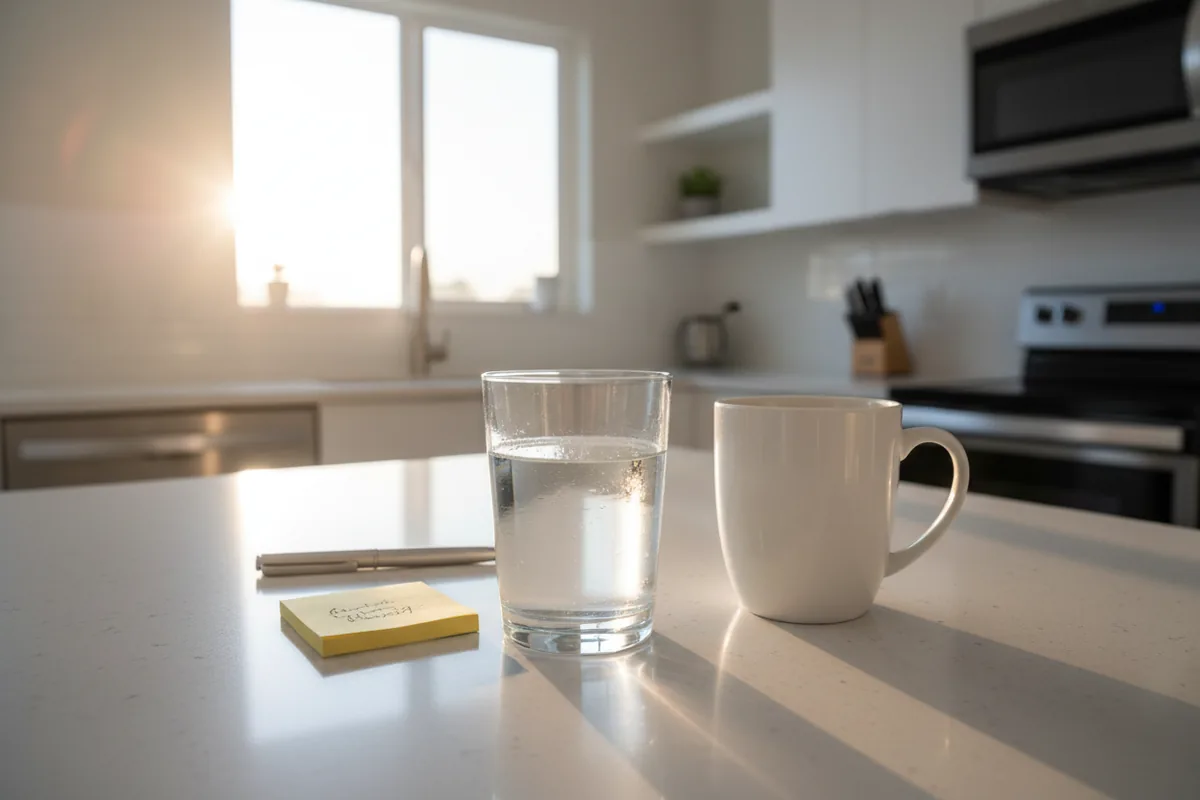
Minutes 1-2 — Light. Open the blinds, step onto the balcony, or eat breakfast by the window. Morning daylight anchors your internal clock, lifts alertness now, and — the underrated part — makes falling asleep easier that night. It's a sleep habit disguised as a morning habit.
Minute 3 — Water before coffee. You wake up mildly dehydrated after 7+ hours without fluids, and dehydration reads as fatigue and fog. A full glass of water first, then coffee — the coffee will still be there, and it'll work better. Keeping a water bottle filled by the bed the night before removes even the effort of thinking.
Minutes 4-7 — Move something. Not a workout — a signal. Twenty bodyweight squats, a set of stretches, a brisk walk around the block, sun salutations if that's your thing. The goal is switching your body from "off" to "on" before the day starts making demands. On rough mornings, 60 seconds of stretching still counts.
Minutes 8-9 — One priority. Ask one question: "What's the one thing that would make today a win?" Write it on a sticky note or a small journal. Not a to-do list — one line. This is the difference between running your day and your day running you.
Minute 10 — Buffer. Because real mornings have spills, lost keys, and kids. A routine with zero slack breaks; one with a built-in buffer bends.
How to Make It Stick
Anchor it to something that already happens. Right after your feet hit the floor, or right after brushing teeth. Existing habits are the strongest triggers — much stronger than alarms or apps.
Prepare the night before. Water bottle filled, blinds cracked, sticky note and pen on the counter. A morning routine is really an evening routine wearing a disguise.
Track streaks, forgive misses. Mark an X on a calendar each morning you do it. Miss one? Fine — never miss two. After about three weeks, the sequence stops requiring thought at all.
Common questions about a 10-minute morning routine
What should you do in the first 10 minutes after waking up? Light, water, and one thing that is yours. Getting daylight into your eyes within the first few minutes is the single highest-value action of the morning because it sets the body clock that decides when you will be sleepy tonight. A glass of water handles the mild dehydration of seven hours without fluid. The third slot is whatever makes the day feel like yours before it becomes everyone else’s — stretching, a few pages, writing three lines.
Is a 10-minute morning routine actually long enough to matter? Yes, because what matters is that it happens every day, not that it is thorough. A ten-minute routine done 300 mornings a year beats a 90-minute routine done fifteen times and then dropped. The long routines fail for a boring structural reason: they only fit on good mornings, and most mornings are not good ones.
Should a morning routine include exercise? It can, but it does not have to, and forcing it in is a common reason short routines die. Two minutes of movement to get blood flowing is plenty inside ten minutes — a proper workout belongs in its own slot, not squeezed into a routine whose job is to start the day calmly. If mornings are genuinely your only training window, make the workout the routine and keep it separate from this.
What if I wake up at a different time every day? Keep the sequence and shrink the routine rather than skipping it. The order — light, water, your thing — works at 5am and at 8am. On the worst mornings, do a two-minute version. A shortened routine keeps the habit alive; a skipped one restarts the counter, and restarting is what actually kills these things.
Is it better to do a morning routine before or after checking my phone? Before, and by a wider margin than it sounds. Once the phone is open the morning stops being yours — you are now responding to other people’s priorities before you have set your own, and the ten minutes disappear without you noticing. If the phone is your alarm, the practical fix is to put it across the room, which also solves the snooze problem.
Final Thoughts
You don't need a better morning routine — you need a smaller one that actually happens. Light, water, movement, one priority. Ten minutes, every day, including the bad ones. In a month you won't remember deciding to do it; it'll just be how your mornings work.
Consistency when the schedule fights back — Read: How Do I Stay Consistent With Habits When My Schedule Changes Every Day?
The evening half of the equation — Read: How to Improve Sleep Quality for Busy Adults Over 30
Fuel the morning right — Read: What Are the Best High-Protein Breakfasts for Busy Mornings?
(Affiliate links below — I only recommend products I genuinely believe in. Purchasing through these links supports this blog at no extra cost to you.)
Small tools that help the routine stick: