How Do I Get Back Into Exercise After a Long Break? (Without Injury or Burnout)
Coming back to exercise after months or years off? The realistic 4-week comeback plan for adults over 30 — no injuries, no burnout, no guilt.

As an Amazon Associate I earn from qualifying purchases.
Six months off. Maybe a year. Maybe since before the kids. Coming back to exercise after a long break has one classic failure mode: starting at the level you remember instead of the level you're at. Your motivation is at 100%, your tendons are at 40%, and that gap is where comebacks die — usually in week three, with a sore knee and a bruised ego.
Quick Answer
Start at 50% of what you think you can do, for two weeks. Three short sessions a week — 15-20 minutes of walking, bodyweight basics, and light mobility. Add roughly 10% per week. Your heart and lungs adapt in weeks; tendons and joints take months. The comeback that feels "too easy" at the start is the one that's still going in December.
Why the First Three Weeks Decide Everything
Muscles recover fast and remember faster — "muscle memory" is real, and strength returns quicker the second time around. But connective tissue (tendons, ligaments, joint cartilage) rebuilds on a much slower clock and gives almost no warning before it complains. That's why the classic comeback injury isn't a dramatic accident — it's a nagging knee, shoulder, or lower back in week 2-3, right when your cardio starts feeling great and you push harder.
The other killer is scheduling nostalgia: planning five sessions a week because that's what you did at 27. Miss two, feel like a failure, quit. The plan has to fit your current life, not your old one.
The 4-Week Comeback Plan

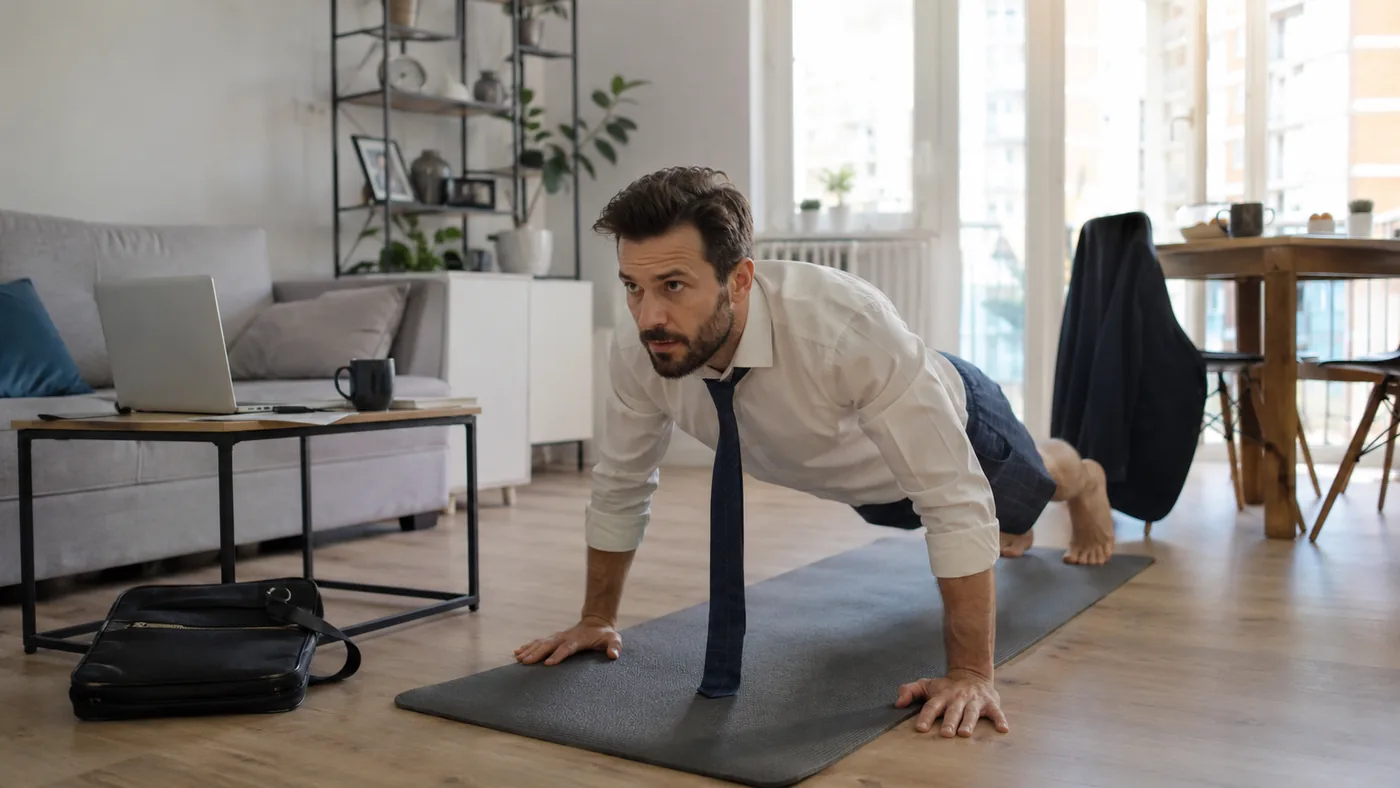
Week 1-2 — Rebuild the habit, not the body: Three sessions, 15-20 minutes. A brisk walk, then 2 rounds of: 10 squats, 5-10 push-ups (knees are fine), a 20-second plank, 10 glute bridges. A basic workout mat and floor space is the entire gym. If it feels too easy — perfect. You're teaching your schedule, your joints, and your identity that this is happening again.
Week 3-4 — Add load, gently: Same three days, 25-30 minutes. Add resistance bands for rows and presses, a third round of the circuit, slightly faster walks or light intervals.
Week 5+ — Now you can train: With a month of consistency behind you, add real resistance — a set of adjustable dumbbells covers years of home progression — or return to the gym with a base that can handle it.
The Rules That Keep You in the Game
Soreness is fine, joint pain is a stop sign. Muscle soreness a day later means you worked; sharp or persistent pain in a joint means back off that movement for a week.
Never miss twice. One skipped session is life happening. Two in a row is a new habit forming in the wrong direction — protect the next one fiercely.
Track showing up, not performance. For the first month, the only metric that matters is sessions completed. Strength numbers come back on their own; consistency doesn't.
Final Thoughts
The goal of your comeback isn't to get fit in four weeks — it's to still be exercising in four months. Start embarrassingly small, add slowly, and let your joints catch up to your enthusiasm. The version of you from years ago isn't the competition; the version who quit in week three is.
The workout to graduate into — Read: What Is the Most Effective 20-Minute Workout for Busy Adults Over 30?
Protecting your joints along the way — Read: Best Low-Impact Exercises to Stay Fit After 30 Without Injuries
When work leaves you drained — Read: How Do I Build a Consistent Workout Habit When I'm Always Tired After Work?
(Affiliate links below — I only recommend products I genuinely believe in. Purchasing through these links supports this blog at no extra cost to you.)
The minimal comeback kit:
Frequently Asked Questions
How do I get back into exercise after a long break?
Start at roughly half of what you think you can handle, twice a week, for the first two weeks. The limiting factor after a layoff isn't your heart or lungs — it's tendons and connective tissue, which adapt far slower than muscle. Almost every comeback injury comes from week one being too ambitious.
How long does it take to get fit again after months off?
Cardiovascular fitness comes back within a few weeks. Strength returns faster than it was built the first time, thanks to muscle memory. Expect to feel roughly normal in four to six weeks if you don't interrupt the comeback with an injury.
Why am I so sore after starting again?
The first two weeks after a break produce disproportionate soreness even from easy sessions. It settles quickly. Keep moving on sore days — gentle walking helps more than complete rest — and resist adding intensity until the soreness stops.
Should I start with cardio or strength after a long break?
Both, lightly. Two short full-body strength sessions plus daily walking rebuilds more usable fitness than cardio alone, and strength work is what protects your joints as you add intensity later.
What if I stop again after two weeks?
Then restart, at the same reduced level, without treating it as evidence about yourself. Most people who train consistently for years have restarted many times. The restart is the skill.